
AI in Quality Management

How 8D reports, audits, and inspection reports are turned into actionable knowledge
AI in quality management delivers its greatest value where a company’s own knowledge lies: in closed complaints, 8D reports, audits, and test reports. An AI assistant that understands the content of these records can identify previous cases along with their root causes and effective corrective actions. This works even if the cases are named differently, documented at a different location, or in a different language. The prerequisite for this is QM software that stores processes in a structured manner and links them together.
No general AI system can answer the most important question in quality management
In quality management, one question matters above all else: Why did this error occur, and have we resolved it before? No general-purpose AI system has an answer to that. The answer lies in a company’s own documentation, and that is precisely where the added value for businesses lies.
The key information is in the body text, not in the fields
Every 8D report, every audit, and every inspection report adds to a company’s body of knowledge. This knowledge accumulates incidentally, process by process, over the course of years. The structured fields of an 8D report specify the type of defect, the component, the supplier, and the status. They document that an incident occurred. The substantive content lies elsewhere: in the root cause analysis, in the audit findings, and in the nonconformities listed in the inspection report. There, for example, it states that a burr on the injection mold damaged the sealing surface because the maintenance interval was not adjusted after 180,000 shots. It also states that replacing the mold cavity was what ultimately solved the problem.
It is precisely this knowledge that speeds up the next analysis—provided it can be found.
Why field and full-text search do not index this collection
A keyword search only finds results with the exact same name. In practice, however, teams describe the same situation in different ways:
- Terminology: “Leak,” “leakage,” and “failed leak test” all refer to the same thing.
- Modules: The cause is documented in the 8D report, the corrective action in the corrective action module, and proof of effectiveness in the test report.
- Locations: Each plant documents in its own level of detail and using its own abbreviations.
- Languages: A corporate group documents in German, English, and Czech; a keyword search recognizes only one of these languages.
Without a structured database, AI remains a matter of guesswork
AI is only as good as the data it works with. If complaints are stored as emails, 8D reports as Excel files, and audits as Word documents, the AI lacks context and connection. The results then amount to nothing more than guesswork. In inforum, complaints, 8D reports, audits, corrective actions, inspections, and sampling are all part of a single system. This fulfills three prerequisites that AI needs in quality management:
- Structure: Each process has a type, status, component, and location.
- Link: The complaint is linked to its 8D report, and the audit is linked to its corrective actions.
- Permissions: The system determines who is authorized to view which processes.
How OKI answers a question that spans module boundaries
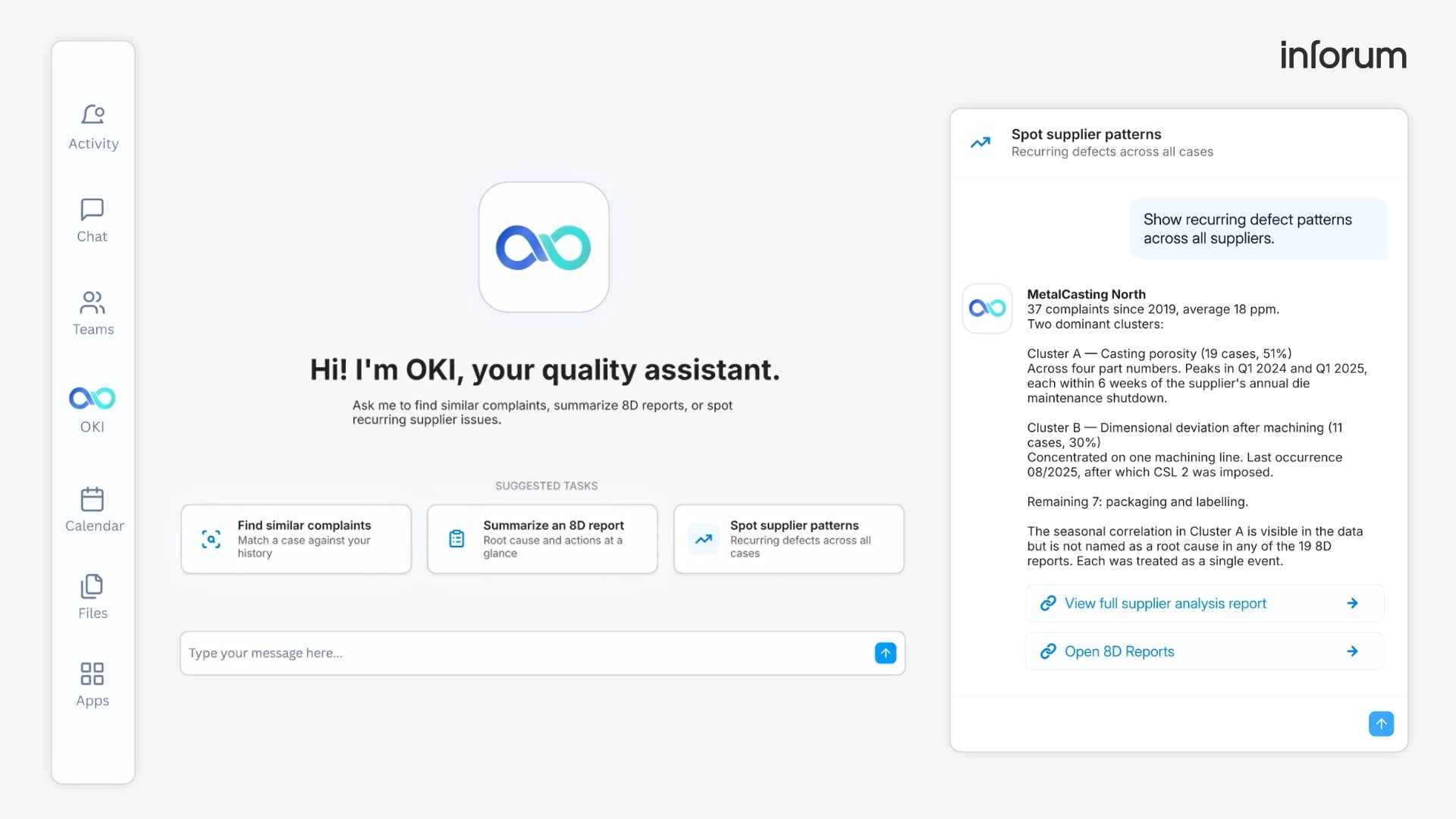
OKI, the AI assistant in inforum, accepts questions in everyday language. An orchestrator breaks down the question and assigns the subtasks to specialized agents for complaints, 8D, audits, sampling, and testing. It then compiles the partial results into a single response. The person asking the question doesn’t need to know where the information is located.
For example, the question “What measures have been proven effective at Supplier X over the past two years?” touches on four modules at once: complaints, 8D, corrective actions, and audits.
Even the question “Have there ever been leaks in housings, and what helped?” does not yield a list of 40 results. OKI responds directly, something like this (illustrative example):
- Graz Plant, 8D Report (“Leak”): The cause was a burr on the mold; after replacing the cavity, the corrective action was effective.
- Brno Plant, 8D Report (“netěsnost”): The sealing material was incorrectly specified; the supplier was changed.
- Linz Plant Audit, Finding (“Test Bench Leakage”): The test pressure was adjusted.
Each answer cites its sources. The team verifies the results instead of searching for them first.
The analysis begins with a knowledge advantage
The process for addressing a new failure pattern has changed significantly. Previously, the team relied on memory and keywords. With AI agents, comparable cases with documented causes are available before the 8D team meets. Proven measures are brought to the table first.
This makes existing knowledge the starting point for every analysis and eliminates the reliance on chance. The expertise of individual specialists remains available, even if they leave the company.
What AI agents do in day-to-day quality management
- Get to the root cause faster: Previous cases, including their causes and corrective actions, are available before the analysis begins.
- Fewer recurring errors: Proven solutions from other plants and modules can be identified and reapplied.
- Knowledge stays within the company: The experience is embedded in the platform. A change in personnel does not result in a loss of historical data.
- Efficient audit and report preparation: Findings, pending actions, and supporting documentation can be compiled across modules.
A look at the technology
Four technical components ensure the reliable use of AI in quality management:
- Semantic search using a vector database: Text from modules and documents is stored as meaning vectors. Similar topics are grouped closely together, regardless of wording or language.
- MCP as an open integration standard: The Model Context Protocol connects models with tools and data sources. The standard is open, vendor-neutral, and can be extended to include additional systems.
- Local or cloud-based models: Local models store all data in the organization’s own data center. Cloud-based models are larger and perform better when handling complex queries involving long documents. For semantic search in QM, local models are sufficient, as the quality of the answers depends on the structured database, not on the model size. They reach their limits when performing complex analyses of very long texts.
- Unchanged permissions: The existing permissions from inforum apply. Responses contain only processes for which the person making the request is authorized.
Frequently Asked Questions
What specific benefits does AI offer in quality management?
AI turns completed processes—such as 8D reports, audits, and inspection reports—into actionable knowledge. Teams can identify past cases along with their root causes and effective corrective actions, giving them a knowledge advantage from the start of every analysis.
What data does an AI assistant need in quality management?
Structured and linked processes—including type, status, component, and location—as well as defined permissions are required. Scattered, unconnected files do not provide reliable answers.
Does semantic search work across multiple languages?
Yes. Semantic search recognizes comparable situations regardless of terminology or language—for example, in German, English, and Czech reports.
Can the AI models be run locally?
Yes. The language and embedding models can run either in the cloud or locally in your own data center. When operated locally, no data leaves the company.
Does the AI assistant see confidential processes?
The responses contain only processes for which the person making the request has authorization. The existing permissions from inforum apply.
Free AI potential assessment
How much knowledge is embedded in your processes? The free AI Potential Check answers three questions:
- In which systems and in what format are your complaints, 8D reports, audits, and inspection reports currently stored?
- How well are root causes, corrective actions, and supporting documentation linked together?
- Where is the best place to start, and where should the database be expanded first?